

Flexible Hybrid Electronics Market Set to Reach USD 1,287.45 Million by 2035 at 16.86% CAGR
Flexible Hybrid Electronics Market
Flexible Hybrid Electronics Market Size, Share and Research Report By Component-Flexible Displays, Flexible Sensors, Flexible Batteries, Flexible Memory, Others
Rising demand for lightweight, wearable, and flexible electronic devices is accelerating growth in the flexible hybrid electronics market worldwide.”
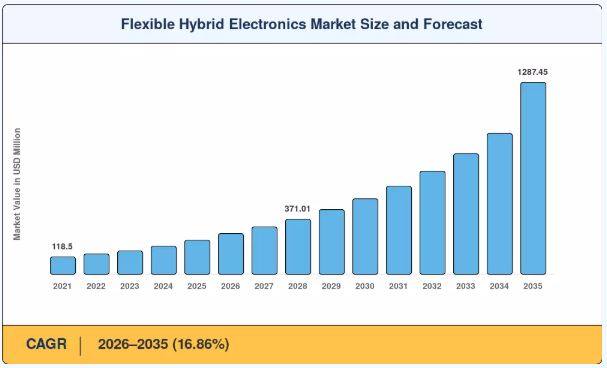
BERLIN, BERLIN, GERMANY, June 23, 2026 /EINPresswire.com/ -- The Global flexible hybrid electronics market reached an estimated USD 229.19 million in 2025 and is projected to grow from USD 271.68 million in 2026 to USD 1,287.45 million by 2035, registering a CAGR of 16.86% during the forecast period. Two major catalysts are driving this trajectory: the accelerating convergence of printed electronics manufacturing techniques with conventional semiconductor components which has enabled the production of conformable, lightweight electronic systems that are reshaping wearable health monitoring.— Market Research Future (MRFR)
Smart packaging, and military platform modernization and mounting defense and aerospace procurement demand for conformal electronics capable of integrating seamlessly into curved structural surfaces, flexible substrates, and human body contours. With global FHE system deployments spanning medical biosensors, asset tracking labels, structural health monitoring patches, and next-generation soldier systems, flexible hybrid electronics are transitioning from research curiosity to production-scale technology platform.
Legacy rigid printed circuit board (PCB) architectures are giving way to FHE platforms that combine the high-performance computing power of thinned silicon ICs with the conformability, low weight, and low-cost manufacturing scalability of printed electronics substrates. A recent NextFlex consortium analysis estimated that FHE-enabled wearable biosensor patches achieved 40–55% reductions in device weight and form factor compared with equivalent rigid PCB-based systems, while maintaining equivalent signal processing performance. This design revolution is not incremental it fundamentally re-architects how electronics are manufactured, integrated into products, and deployed across the human body, industrial structures, and defense platforms.
Get Full PDF Sample Copy of Report: (Including Full TOC, List of Tables & Figures, Chart) @
https://www.marketresearchfuture.com/sample_request/24175
➤ How Significant Is the Flexible Hybrid Electronics Market’s Growth?
The flexible hybrid electronics market has demonstrated robust and accelerating expansion, rising from approximately USD 98.7 million in 2021 to an estimated USD 229.19 million in 2025, reflecting a strong historical growth trajectory underpinned by sustained U.S. Department of Defense investment through the NextFlex Manufacturing USA Institute, expanding commercial wearable health technology demand, and breakthroughs in stretchable substrate materials and low-temperature sintering conductive inks. The market is projected to grow more than fourfold over the next decade, propelled by the industrialization of roll-to-roll FHE manufacturing, the commercialization of FDA-cleared wearable biosensor patches, and the integration of FHE assemblies into electric vehicle battery management and structural health monitoring systems.
Rising demand for ultra-thin, conformal, and body-worn electronic systems across healthcare, military, consumer electronics, and industrial IoT applications has created acute demand for manufacturing platforms capable of producing electronics that bend, stretch, and conform to complex three-dimensional surfaces. Traditional electronics manufacturing cannot address these form factor requirements without compromising either performance or manufacturability a gap that flexible hybrid electronics platforms are uniquely positioned to fill. Medical device OEMs, defense prime contractors, consumer electronics brands, and smart packaging innovators are all investing in FHE design capabilities and supply chain partnerships to access this enabling technology.
➤ What Does the Future Hold for the Flexible Hybrid Electronics Market?
Advanced materials innovation and additive manufacturing process maturation stand at the forefront of the market’s next growth phase. The development of highly stretchable conductive inks, biocompatible encapsulation materials, and ultra-thin thinned-die bonding techniques is enabling FHE system designers to achieve previously impossible combinations of mechanical flexibility, electrical performance, and environmental durability. Silver nanowire-based conductive inks, gallium-indium liquid metal interconnects, and aerosol jet-printed antenna structures are among the material innovations transitioning from laboratory to manufacturing environments, supported by growing commercial ink and substrate supply chain infrastructure.
Healthcare and medical wearables represent the highest-growth commercial application segment for FHE technology through 2035. Continuous health monitoring patches capable of simultaneously tracking ECG, SpO2, respiration rate, skin temperature, and galvanic skin response all from a single conformal, adhesive-backed FHE assembly are advancing through FDA clearance pathways at an accelerating pace.
Remote patient monitoring programs, enabled by FHE biosensor patches with integrated Bluetooth low-energy (BLE) radios and onboard edge AI inference chips, are emerging as a critical infrastructure layer for post-acute and chronic disease management, reducing hospital readmission rates and enabling earlier clinical intervention.
Defense and aerospace applications will continue to be the largest single end-use market for FHE systems through the mid-2030s.
The U.S. Army’s Soldier as a System modernization programs, next-generation unmanned aerial vehicle (UAV) structural integration requirements, and conformal antenna arrays for electronic warfare platforms are all creating sustained procurement demand for high-reliability FHE assemblies. DARPA’s Electronics Resurgence Initiative and the DoD’s broader Microelectronics Strategy are channeling significant R&D investment into FHE manufacturing process maturation, supply chain resilience, and domestic production scaling providing a durable government demand floor for the technology throughout the forecast period.
➤ Who Are the Key Players in the Flexible Hybrid Electronics Market?
The flexible hybrid electronics landscape is characterized by a combination of defense-focused technology developers, printed electronics specialists, semiconductor packaging innovators, and vertically integrated FHE system integrators. Key participants shaping the competitive dynamics include:
★NextFlex
★Brewer Science
★Flex Ltd.
★Jabil Inc
★DuPont de Nemours
★Henkel AG
★Thin Film Electronics (Thinfilm)
★American Semiconductor
★Enfucell
★Molex LLC
Competition in the market is intensifying as participants race to develop scalable roll-to-roll FHE manufacturing processes capable of high-volume production, expand qualification of FHE assemblies for high-reliability defense and medical applications, and establish intellectual property positions in stretchable substrate materials, biocompatible encapsulation systems, and integrated energy harvesting architectures. Strategic partnerships between materials suppliers, semiconductor manufacturers, and system integrators are reshaping the FHE supply chain and accelerating the transition from prototype-scale to production-scale manufacturing.
➤ What Are the Emerging Trends in the Flexible Hybrid Electronics Market?
Several transformational trends are redefining how the flexible hybrid electronics market evolves through 2035:
Stretchable & Skin-Conformal Electronics: Next-generation FHE systems utilizing serpentine interconnect geometries, kirigami-patterned substrates, and intrinsically stretchable conductors are enabling electronics that conform to and move with the human body unlocking continuous, motion-artifact-free biometric monitoring during physical activity and clinical procedures.
Integrated Energy Harvesting: The combination of flexible photovoltaic cells, piezoelectric energy harvesters, and thermoelectric generators with FHE electronics platforms is enabling self-powered wearable and IoT sensor systems that eliminate battery replacement requirements in inaccessible or implanted device applications.
AI-at-the-Edge on FHE Platforms: The integration of ultra-low-power neuromorphic and edge AI inference chips onto flexible substrates is enabling onboard machine learning inference for real-time biosignal classification, anomaly detection, and predictive maintenance reducing data transmission requirements and enabling autonomous operation in connectivity-constrained environments.
Smart Packaging & Anti-Counterfeiting: Printed NFC and RFID-enabled FHE labels are being integrated into pharmaceutical blister packs, luxury goods packaging, and cold chain logistics labels providing authentication, environmental condition monitoring, and supply chain visibility at unit-item granularity.
Structural Health Monitoring (SHM) Integration: Conformal FHE sensor arrays laminated onto aerospace structures, civil infrastructure, and wind turbine blades are enabling continuous strain, vibration, and corrosion monitoring providing real-time structural integrity data that reduces maintenance costs and prevents catastrophic failure events.
Bioelectronic Medicine: Ultra-miniaturized, biocompatible FHE assemblies are enabling a new generation of implantable and semi-implantable neuromodulation, electroceutical, and biofeedback devices that interface directly with neural and cardiac tissue opening transformative new therapeutic modalities for chronic pain, epilepsy, and cardiac arrhythmia management.
Get access to the full description of the report @
https://www.marketresearchfuture.com/reports/flexible-hybrid-electronics-market-24175
➤ How Is the Flexible Hybrid Electronics Market Segmented?
The flexible hybrid electronics market report provides a comprehensive segmentation framework:
By Component: Sensors, Displays, Batteries & Energy Harvesting, Connectivity Modules, Processors & Memory, Antennas
By Application: Wearable Health Monitoring, Defense & Aerospace, Smart Packaging, Consumer Electronics, Automotive, Industrial IoT & Structural Health Monitoring
By Substrate Material: Polyimide (PI), Polyethylene Terephthalate (PET), Polyethylene Naphthalate (PEN), Paper, Thermoplastic Polyurethane (TPU), Others
By Manufacturing Process: Inkjet Printing, Screen Printing, Aerosol Jet Printing, Roll-to-Roll Processing, Photolithography-Hybrid
By End User: Healthcare & Medical Device OEMs, Defense & Government, Consumer Electronics Brands, Packaging & Logistics, Aerospace & Automotive
➤ What Are the Regional Insights from the Flexible Hybrid Electronics Market?
North America commands approximately 48% of global flexible hybrid electronics market share, reflecting the region’s unique combination of sustained DoD investment through NextFlex and related Manufacturing USA institutes, a deep concentration of defense prime contractors and medical device OEMs with active FHE development programs, and world-leading research universities and national laboratories advancing FHE materials science and manufacturing process innovation. The United States is home to the majority of commercial FHE system integrators and materials suppliers, and domestic supply chain resilience imperatives embedded in the CHIPS and Science Act and National Defense Authorization Acts are further reinforcing North American FHE production investment.
Europe holds the second-largest share at approximately 22%, with Germany, the United Kingdom, Finland, and the Netherlands leading in FHE research, materials development, and early commercial adoption. The European Commission’s Horizon Europe program has funded multiple large-scale FHE research consortia focused on medical wearables, smart textiles, and automotive sensor integration. Germany’s Fraunhofer Institute network provides critical applied research and technology transfer infrastructure linking FHE materials innovation with industrial manufacturing scale-up, while the UK’s Innovate UK programs are supporting FHE commercialization in healthcare and defense applications.
Asia-Pacific represents the fastest-growing region, projected to register a CAGR exceeding 15% through 2035, driven by Japan’s world-leading printed electronics industry, South Korea’s display and flexible semiconductor manufacturing infrastructure, and China’s rapidly scaling investment in domestic printed electronics and flexible device manufacturing capabilities. Japan’s NEDO-funded flexible electronics research programs and South Korea’s Samsung and LG-led flexible display technology ecosystems provide a strong foundation for adjacent FHE commercialization across consumer electronics, automotive, and healthcare applications.
The Rest of World encompassing Latin America, the Middle East, and emerging Asia markets currently represents a smaller but growing share of the global FHE market, with early adoption driven primarily by defense procurement programs, smart agriculture sensor deployments, and technology licensing agreements enabling local manufacturing of FHE-based smart labels and packaging solutions. As FHE manufacturing costs continue to decline through process maturation and supply chain scaling, adoption in cost-sensitive emerging market applications is expected to accelerate meaningfully through the second half of the forecast period.
➤FAQs
What minimum order quantities should procurement teams expect when sourcing FHE components from open-access foundries?
Most open-access R2R foundries accept prototype runs as small as 500 units, with volume pricing kicking in above 10,000 units per SKU. Procurement teams should budget 12–16 weeks for first-article qualification
Which regulatory certifications are required for medical-grade wearable flexible hybrid systems in the US and EU?
US-bound devices require FDA 510(k) or De Novo clearance plus ISO 13485 manufacturing certification, while EU placement demands MDR Class IIa or IIb approval with a Notified Body assessment Timeline from submission to clearance averages 9–14 months in both jurisdictions.
➤➤➤ Industry Analysis Reports by Market Research Future:
Particulate Matter Monitoring Market -
https://www.marketresearchfuture.com/reports/particulate-matter-monitoring-market-12356
Fault Detection Classification Market -
https://www.marketresearchfuture.com/reports/fault-detection-classification-market-12463
Ai In Video Surveillance Market-
https://www.marketresearchfuture.com/reports/ai-in-video-surveillance-market-12476
Trimmer Potentiometer Market-
https://www.marketresearchfuture.com/reports/trimmer-potentiometer-market-12506
Servo Motors Drives Market-
https://www.marketresearchfuture.com/reports/servo-motors-drives-market-12562
Thermal Management In Consumer Electronics System Market -
https://www.marketresearchfuture.com/reports/thermal-management-in-consumer-electronics-system-market-12585
Wire Wound Resistor Market-
https://www.marketresearchfuture.com/reports/wire-wound-resistor-market-12592
Automatic Power Factor Controller Market-
https://www.marketresearchfuture.com/reports/automatic-power-factor-controller-market-12710
Autonomous Mobile Robot Market-
https://www.marketresearchfuture.com/reports/autonomous-mobile-robot-market-13407
North America Building Automation Systems (Bas) Market-
https://www.marketresearchfuture.com/reports/north-america-building-automation-system-market-13930
Sagar Kadam
Market Research Future
+ +1 628-258-0071
email us here
Visit us on social media:
LinkedIn
Facebook
X
Legal Disclaimer:
EIN Presswire provides this news content "as is" without warranty of any kind. We do not accept any responsibility or liability for the accuracy, content, images, videos, licenses, completeness, legality, or reliability of the information contained in this article. If you have any complaints or copyright issues related to this article, kindly contact the author above.
